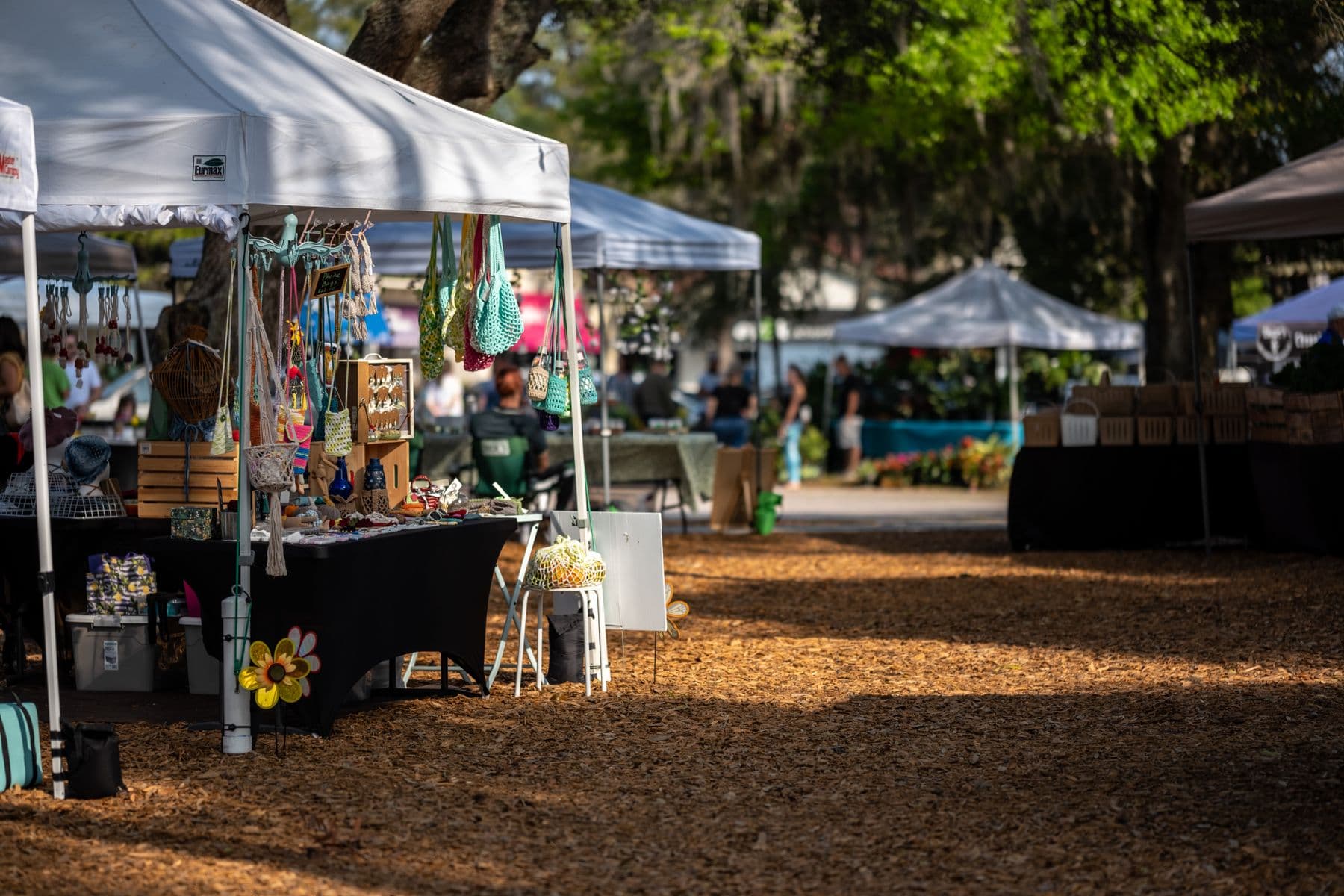
The photographs look irresistible: a row of gazebos, people carrying iced coffees, your work laid out on a table in the sun. Then the application form arrives. There is a stall fee, perhaps a commission, travel, display equipment and a day you could have spent making stock. Will the market actually pay?
For a South African maker, the useful test is break-even sales = market-specific fixed costs ÷ contribution per item, rounded up to a whole sale. Contribution is your selling price less the costs that rise with each sale: materials or stock, packaging, payment fees and any organiser commission. Count the stall, transport and paid help separately. Do this before you book, then decide what else would make the day worthwhile: meeting new buyers, testing a product or earning repeat orders.
A stall fee is only the first line of the quote
Current organiser pages show why a single “average market stall cost” would mislead you. Johannesburg's Field Market lists a 2026 goods-stall fee of R450 for 3 m × 3 m, with a table available for R80. The trader brings the setup and sells at the stall. Cape Town's South Market lists R950 for a full space for its 7–22 December 2026 event and a 19.5% commission on sales. It is fully managed: the maker supplies and restocks products while the organiser handles the sales. These are different contracts and event lengths, not two prices for the same service.
Both examples also show the danger of planning from a date alone. Field Market says its remaining 2026 events are fully booked, and South Market's published application deadline was 29 May 2026. Check the current application status before buying stock for a particular event. The City of Cape Town's market page likewise distinguishes markets with open registrations from those whose applications have closed.
Before paying, ask the organiser for the written terms: space dimensions, what equipment and electricity are included, any commission and payment-processing deduction, when you will be paid, cancellation rules, permitted products, food or alcohol requirements, and how many similar sellers will be there. Ask what the organiser knows about the buyers who attend, not only the total foot count. A crowd looking for lunch is not automatically a crowd for R180 handmade tote bags.
Work out the number of sales you need
Imagine a maker selling a tote bag for R180. Materials and making costs attributable to each bag are R70; packaging and the expected payment cost are R10. The contribution is R100 per bag. Now suppose one staffed market day costs R450 for space, R80 for a table, R170 for travel and R300 for paid help: R1,000 in event costs.
| Calculation | Amount |
|---|---|
| Selling price per bag | R180 |
| Less product, packaging and payment costs | R80 |
| Contribution per bag | R100 |
| Market-specific fixed costs | R1,000 |
| Bags needed to cover those costs | 10 |
At ten sales, the example has covered its listed event costs; it has not made R1,800 profit. At eleven, the additional R100 begins to cover other business overhead and profit. If the maker works alone instead of paying a helper, the cash break-even point falls, but their own time still has value. Set a separate earnings target for that time.
These are illustrative figures, not a typical stall's sales or a recommended price. Use a consistent VAT basis in your own records, especially if you are VAT registered. Our markup-versus-margin guide explains why the money left after product cost is different from net profit.
For a commission-based event, subtract the commission on each sale before calculating break-even. At the same R180 price, South Market's published 19.5% commission would be R35.10 per bag. If product cost is R70 and packaging R5, contribution would be R69.90 before the space fee and any other event costs. That fee model may save time behind a stall, but it also changes the number of units you must sell. Compare the full event period and payout timing, not just the R950 space fee against a one-day R450 fee.
Pack for the customer you hope to see
Once the numbers work, build the stall around a few decisions a passer-by can make quickly. Put a readable price beside each product, bring enough small-ticket options for someone who wants to try your work, and make the best-seller easy to find. Know what you will say when someone asks how the item is made, whether it can be exchanged and how to order another colour after the market.
Take a counted opening stock list and close it against sales, returns and damage. A market can sell out of a hero item while leaving slow stock untouched; “it felt busy” will not tell you which happened. Bring a card-payment method you have tested at the venue, plus a clear fallback for a weak signal. Some phone-based payment methods need live connectivity: Yoco says its Tap to Pay on iPhone requires internet access. Check your own provider and device rather than assuming every terminal works the same way. Our card-machine outage plan covers an uncertain payment at the till.
Give the market sale a second chapter
A buyer may not remember which gazebo sold the bag. Put your business name and a useful reorder route on the receipt or care card. A simple QR code can open your catalogue or site; test it on a phone before printing a stack. If someone asks for a sold-out colour, record the request and offer a specific way to place an order. After the event, follow through on promised collections and fixes promptly. That is a better retention move than a generic “thanks for visiting” blast.
If you invite people to receive offers, make the choice explicit and keep it separate from the purchase or receipt. A number supplied for a digital receipt is not a blanket WhatsApp marketing opt-in. Our POPIA and WhatsApp consent guide explains the South African rules and WhatsApp's own requirements.
Finally, review the event on three lines: contribution from sales minus event costs, which products people actually wanted, and what happened to enquiries after the market. A day can miss its cash target and still reveal a better product or audience; a busy day can look successful while its commission quietly consumes the margin. The numbers tell you whether to book again, and the conversations tell you what to change.
Organiser terms, dates and payment information checked on 3 November 2026. Fees and availability can change; confirm the current contract before committing.
Cover photo: Connor Scott McManus / Pexels, used under the Pexels License. The market pictured is illustrative.