Airbnb vs Booking.com for South African guesthouses: compare the stay, not just the fee
Hydra
Two couples want the same Friday and Saturday in a small Garden Route guesthouse. One finds the room on Airbnb; the other finds it on Booking.com. Both see a neat nightly rate. The owner needs to know something less photogenic: what each guest will actually pay, what the property will receive, and whether the room can be sold twice while calendars update.
For a South African guesthouse, neither Airbnb nor Booking.com is automatically the cheaper or better channel. Compare the full guest price, the net amount left after that property's actual platform and payment charges, the cancellation rules and the work required to keep availability accurate. Then compare completed stays and repeat guests, rather than listing views. This matters especially now because Airbnb is moving home hosts toward a single host-paid fee; a familiar “Airbnb takes only 3%” comparison can be badly out of date.
Platform documentation checked on 13 November 2026. Fees, programmes and account settings can change. Confirm the terms displayed for your own South African property before changing rates.
The fee comparison starts in your account, not a blog table
Airbnb says it is transitioning home hosts from split fees to a single fee. Under the split structure, many hosts pay 3% and the guest also pays a service fee. Under the single structure, most hosts pay 15.5%, while some pay a different rate. Airbnb says the single fee is mandatory for many traditional hospitality listings and hosts using property-management software. Check the fee breakdown on a real reservation or pricing preview; do not assume your guesthouse still uses the split structure.
Booking.com's accommodation terms calculate commission using the percentage in the property's agreement, the room price and certain extras. They do not give every South African property one universal percentage. Participation in visibility programmes can mean a higher commission. Find your signed rate and any programme or payment charges in the Extranet and invoices. A third-party article's “typical 15%” is not your bill.
| Compare for the same dates and room | Airbnb | Booking.com |
|---|---|---|
| Guest-facing total | Check nightly price, cleaning or other charges, service fee if split, and taxes shown before payment. | Check the final guest total, breakfast or other included extras, and any programme discount. |
| Property cost | Use the service fee on the booking's price breakdown and any applicable tax or processing detail. | Use your contracted commission, its calculation base, payment charges and programme costs. |
| Payout timing and responsibility | Check how and when the reservation is paid out, and who handles any remaining charges. | Check whether your property collects from the guest or uses Booking.com's payment service. |
| Operational fit | Test the listing, cancellation setting, messages and calendar for your room type. | Test the room inventory, rate plan, cancellation setting, messages and calendar. |
An example shows why the percentage alone is insufficient. Suppose a two-night stay has a R2,400 booking subtotal and Airbnb's single host fee is 15.5% on that subtotal. The fee would be R372, leaving R2,028 before other applicable costs. If a different platform's actual contracted commission were 15% on precisely the same R2,400 base, that illustrative commission would be R360. The R12 difference says almost nothing until you compare guest totals, included breakfast, payment charges, cancellations and the number of stays that actually happen. The 15% is a hypothetical input, not a published Booking.com rate for South Africa. Airbnb's own fee explanation also shows why the split-fee guest total cannot be compared with a single-fee host payout as if both began at the same price.
The biggest operational risk is selling one room twice
If you list one room on both sites, make a booking on one channel block the same dates on the other. Airbnb explains how to import and export calendar links, but says imported calendars refresh automatically about every three hours. That delay is important on a busy weekend. An iCal link is useful for a small property; it is not an instant guarantee against a double booking.
For a property with several rooms or rate plans, test a channel manager or booking system with one real room and one blocked date before trusting it with the full inventory. Check that a direct booking, a phone booking, maintenance closure and a cancellation propagate correctly. Keep one person responsible for exceptions. If you cannot confirm a sync is working, temporarily close the room on the other channel while you resolve it. The apology and relocation cost after an overbooking can be far larger than a small commission difference.
Compare the guest you can welcome, not just the reservation
A family booking a two-night holiday and a sales representative returning monthly create different value for a guesthouse. Neither platform guarantees either type. Record the source, length of stay, completed or cancelled status, support time, and whether that guest later books again. If a guest asks for a cot, parking or an early breakfast, make sure the information reaches the property before arrival whichever channel they used. Accurate pre-arrival details and a good check-in are retention work, not merely hospitality niceties.
After the stay, make a direct booking route easy to find on your website, invoice and in-room information. Give returning guests a clear way to ask about availability and the terms of a future stay. Do not move an existing platform reservation off-platform or assume you can use guest contact details for unrelated marketing; follow the terms of the booking channel and the guest's communication preferences. For direct enquiries, publish the total price, deposit and cancellation terms plainly so a guest can compare with confidence.
For a small South African guesthouse, the most useful monthly sheet is one line per channel:
- Completed room nights and gross guest revenue for that channel.
- Platform commission or host fee, payment charges and any funded discount.
- Direct costs of the stay, such as cleaning and breakfast, on a consistent basis.
- Cancellations, overbookings and staff time needed to resolve problems.
- Returning guests, counted by the source of their first stay and the channel of their next one.
That sheet will not make every booking comparable: a winter Tuesday and a December Saturday are different inventory. It will show whether one channel brings profitable occupied nights and guests who would happily return. If you are considering a wider direct-booking plan, start by fixing availability and the guest journey. A cheaper booking is only valuable when the room is ready, the promise is clear and the guest wants to come back.
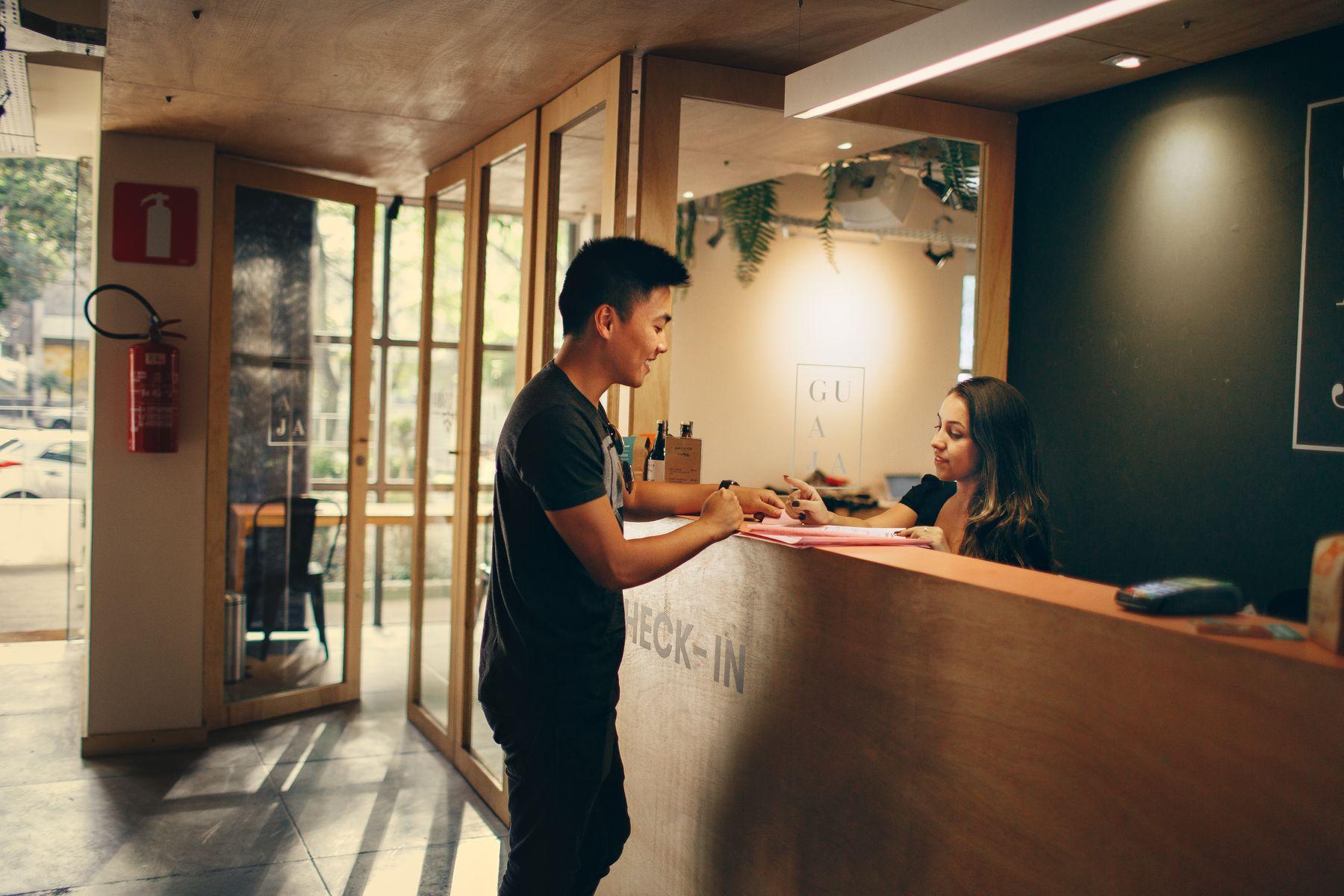
Cover photograph: Helena Lopes on Pexels, used under the Pexels License. The image shows a check-in in Brazil; it does not depict the example South African guesthouse or imply endorsement of Hydra, Airbnb or Booking.com.